









-

Guides
The Loyalty Landscape
Our #ShowUpForHospitality campaign is shining a light on an issue that has been a blight on the sector for far too long – our research reveals that customer no-shows collectively cost the hospitality sector a staggering £17.6bn per year. No matter where a venue is situated from Lands’ End to John O’Groats, they will have been impacted by no-shows.
However, by digging deeper and breaking down the research by region, we can bring to light trends and attitudes driving this consumer behaviour and, importantly, insights which can help operators put a stop to no-shows.
A nation divided?
From your favourite pub food, to whether you prefer coffee or tea, there are many lines you can divide the UK down, but are no-shows one of them? Well, not quite. While there are certainly differences in consumer attitudes, it’s not so easy to split the UK down the middle when it comes to the prevalence and reasons for no-shows.
What does stand out however, is that people living in London are by far the worst offenders’ with nearly a quarter of Londoners admitting to no-showing since the hospitality sector reopened in April 2021. Next in the ‘league of shame’ is the West Midlands (17%), followed by the East Midlands (16%) and the North West (15%).
However, there’s no obvious North-South divide when it comes to consumer behaviour around no shows, neither is their obvious difference between guests in England compared to those in Wales and Scotland. Consumers in the South West and South East are just as likely to show up for a reservation as they are in Scotland and Wales.
The No-Show league of shame
Urban vs Rural
Looking closer at the worst offenders, London, the West Midlands, the East Midlands and the North West – all these regions have significant urban populations. London is by far our biggest city and capital, the West Midlands comprises our second city Birmingham as well as Coventry, the East Midlands has Nottingham, Leicester, Derby and the North West with Liverpool and Manchester.
So, it’s not a great leap to conclude that consumers in city or even town centres are more likely to no show and the data backs this up. Our research shows that 14% of consumers in city centres have no showed this year, rising to 18% for consumers in town centres. The comparison with consumers in rural or suburban areas is also stark – only 5% of pub and restaurant goers in rural areas have not shown up to a booking and not told the venue in advance. The figure is just 3% for consumers in suburban areas.
There is an understandable logic to these differences as those in city and town centres have a faster-paced lifestyle, greater degree of choice and, perhaps, a more transactional relationship with pubs and restaurants. Customers are far less likely to not show up for a booking at their local village pub, than a booking at a mainstream city centre restaurant.
There’s also likely an assumption that these centrally-located venues are far more likely to be able to fill empty tables with walk-ins. However, with significantly reduced footfall in these locations as a result of the pandemic and people increasingly staying local, that opportunity has been dramatically reduced. This means no-shows are having an even greater impact on operators who are desperately trying to rebuild after a devastating 18 months.
Using tech to tackle no-shows
Communicating with customers, reminding them of their booking and giving them the means to cancel if necessary are crucial tools for operators in tackling the problem. However, there are some interesting nuances when it comes to consumer attitudes to these approaches. Over half (58%) of consumers prefer to cancel digitally, either via a website (21%), text (19%), app (10%), email (7%) social media (1%). However we are seeing that the worst offending regions are also the most tech-savvy. Londoners are the most likely to prefer to cancel digitally (69%), again followed the West Midlands (60%). The correlation between these regions and consumers in city and town centres also continues. Some 68% of city centre and town centre consumers prefer to cancel digitally compared to 49% in rural and 53% in suburban areas.
For businesses that operate venues in city or town centre locations, a frictionless and easy-to-use online booking system is crucial to reducing no-shows. However, no matter where a venue is located, providing customers with multiple options to amend or cancel their reservation whether that be via SMS, online or app, should be part of an operator’s toolkit.
The #ShowUpForHospitality campaign aims to bring to attention the huge impact no shows and to try and change consumer behaviour, but also to understand what drives that behaviour. Pubs, bars and restaurants play a vital role in our communities and while the pandemic has prompted a new-found appreciation and understanding of hospitality among many consumers, there is still more to be done in encouraging them to always honour their booking or tell the venue in advance.
We want to spread this message far and wide and keep the conversation going, so to get involved simply visit the campaign page to join the conversation and encourage customers to #ShowUpForHospitality via LinkedIn, Instagram and Twitter.

Join the conversation and help us make no-shows a thing of the past
No-shows cost the hospitality industry an estimated £17.59 billion in lost sales every year. Join our group of passionate industry supporters to help spread the message far and wide and encourage customers to #ShowUpForHospitality.
No-shows remain a thorn in the side of the hospitality industry across the UK with the national no-shows rate rising to 14%, again costing the industry an estimated £17.59bn in lost revenue every year.
Changing the behaviour of customers for the long term will take a huge collective effort from the industry, and as operators, there are many things that you can do in the interim to reduce the impact of no-shows on your venue.
Our in-house team of bookings experts have put together a checklist of ideas on how you can eliminate no-shows in your hospitality business:
By following these steps, you’ll be able to convert no-show-ers to always go-ers, meaning more revenue for your business and happier customers!
Join the conversation and help us make no-shows a thing of the past
No-shows cost the hospitality industry an estimated £17.59 billion in lost sales every year. Join our group of passionate industry supporters to help spread the message far and wide and encourage customers to #ShowUpForHospitality.

The latest GO Technology report from Zonal and CGA revealed that one in seven people admit to failing to honour their reservations since hospitality reopened in April. But what do we know about these no-shows, and what can you do about it?
In this webinar industry experts from CGA, Bums on Seats and Zonal discuss the damaging impact customer no-shows have on operators and what you can do to tackle them.
Key insights include:
Speakers:
Join the campaign to make no-shows a thing of the past
No-shows cost the hospitality industry an estimated £17.6 billion in lost sales every year. Join our group of passionate industry supporters to help spread the message far and wide and encourage customers to #ShowUpForHospitality.

Guest blog by Amber Staynings, CEO & Founder, Bums on Seats
Ah, the old ‘No-show’ debate. No-shows have been an ongoing problem in hospitality ever since I can remember. I’ve conducted audits upon audits for businesses in our sector and in most cases, they all have one thing in common: an incredibly high no-show rate, with few processes to minimise its’ impact.
To put a more positive spin on it, minimising no-shows means more accurate financial forecasting and -more importantly- a far better guest experience which encourages loyalty and repeat business. But how can you reduce no-shows for your business?
The first option for any operator is introducing deposits to secure bookings. I understand the apprehensions around introducing deposits – will it put customers off? Put it this way: do I really believe a customer will book elsewhere because we ask for a £5pp deposit to secure a booking when it’s redeemable? No, I don’t- not anymore. Customers want security when they book- by asking for a deposit you’re simply giving them the reassurance they want.
If the whole sector agreed to tackle no-shows in the same way and implement a deposit system, then this issue would resolve itself to everyone’s satisfaction: customers would commit to one venue (rather than booking 2 or 3 places and only turning up to 1), no-shows would drop dramatically and those who don’t want to put down a deposit can become your more casual ‘walk-in’ diners. The action of introducing deposits alone will go a long way to reassuring our staff, protect revenue, and give us the confidence to up-sell packages and experiences.
Another contributing factor to no-shows is a lack of relationship between the business and the customer. Our sector prides itself on providing customers with truly wonderful memories and experiences with their friends and loved ones, but this doesn’t just start when the customers walk through the door – it’s the minute they first submit that online enquiry or pick up the phone to book.
Securing sales and improving guest loyalty requires the quality of your relationship to be scrutinised and put centre stage. Treat your customers as you would your close friends: by doing this, you create that all-important emotional connection. Customers will cancel in advance if they can’t come because they’ll feel bad: you’re not a building with a kitchen to them anymore. You’re family.
My job at Bums on Seats is increasingly to help established sales teams or individuals to acquire the skills to build and capitalise on these important relationships, without which hospitality cannot reduce no-shows substantially and go on to grow the bottom line through repeat business, new revenue streams, and ongoing customer loyalty. It is perfectly feasible with the right guidance, training and support to achieve a no-show rate of less than 10%, followed by accurate pre-bookings and more advance spending through up-selling packages and bolt-ons. This investment is needed – and justifiable – now more than ever.
As we’re about to enter our busiest period of the year, Christmas, now is the time to put these processes in place, effectively. Start by pulling together to invest in the right booking system for online payments, pre-orders and packages. Re-write your terms and conditions to reflect your own brand culture and language, and include a commitment to refund the deposit if a customer cancels within 24 hours of the event/table. Use SMS texts (where affordable) or personal calls which are proven to work by prompting customers and helping to avoid ‘no shows’, as well as building up a crucial relationship which encourages loyalty. By treating your customer as a friend and making it easier for them to cancel if they have to, you will have put your business back on the front foot and can look forward with increasing confidence.


Join the conversation and help us make no-shows a thing of the past
No-shows cost the hospitality industry an estimated £17.59 billion in lost sales every year. Join our group of passionate industry supporters to help spread the message far and wide and encourage customers to #ShowUpForHospitality.
The latest GO Technology report from Zonal and CGA reveals that no-shows are now costing the industry a staggering £17.6bn a year and rising, exacerbating the devastating financial impact of the pandemic.
Since hospitality venues reopened in April 2021, the report identifies 14% of consumers have failed to turn up for a reservation without telling the venue, with one in eight (12%) people saying they are more likely to no-show than they were before the pandemic.
The research also highlights a strong correlation between no shows and age, with 18–34-year-olds being the worst offenders when it comes to no-shows. Over a quarter (28%) of 18-34-year-olds have not honoured their bookings, compared to just 1% of those aged 55 or over.
Discover more about the true scale of the problem, why consumers aren’t fulfilling their bookings as well as their current views on deposits, reminders and cancellations.
Download the full report using the form on the right to discover all the findings.
Join the campaign to make no-shows a thing of the past
No-shows cost the hospitality industry an estimated £17.6 billion in lost sales every year. Join our group of passionate industry supporters to help spread the message far and wide and encourage customers to #ShowUpForHospitality.
This report is based on figures from Zonal and CGA’s GO Technology survey, a sample of 5,000 nationally representative British consumers. All figures are taken from the 2021 editions of the survey.

Three sites: The Bridge Inn, Ratho, The Crusoe, Largo and The Ship Inn, Elie – Scotland

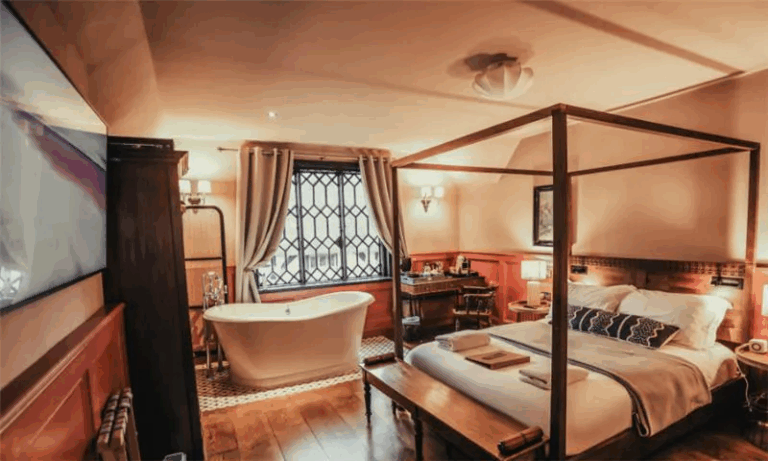
10 beautiful, boutique guest bedrooms

Winners of Scotland’s AA Pub of the Year

Each with a unique venue, vibe and flavour
“We were facing inefficiencies with checks being missed and walkouts – the whole solution was complicated for staff.”Graham Bucknall, Director, The TBC Pub Company
As champions of quality local and seasonal produce, the TBC Pub Company were looking to invest in a high-quality, integrated technology suite to match – to improve efficiencies and maximise revenues across their three sites and deliver an even better customer experience.
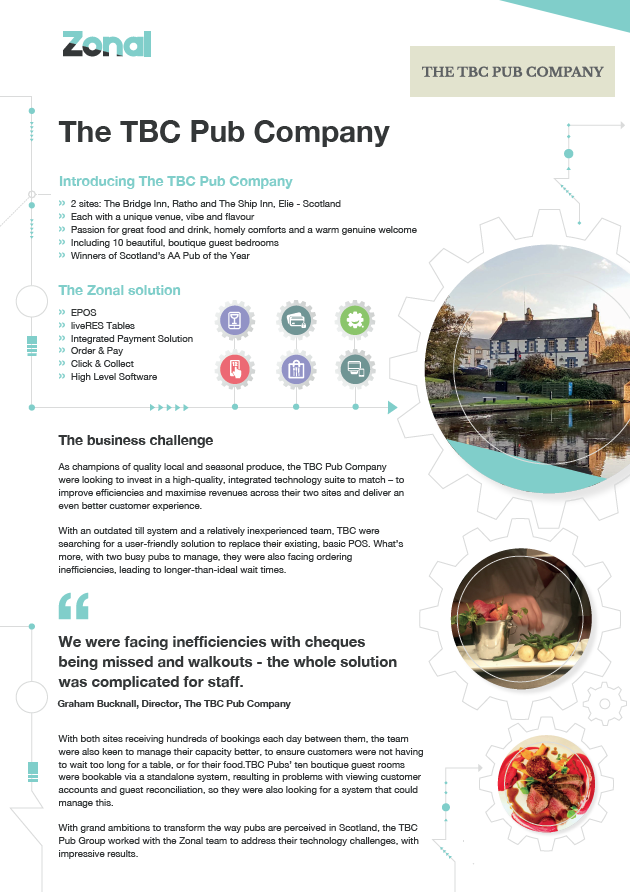
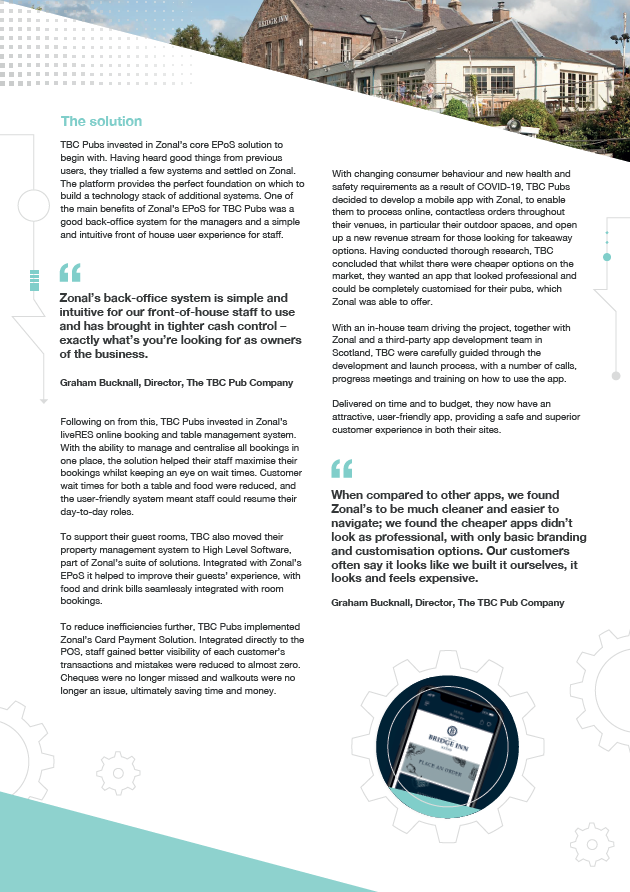
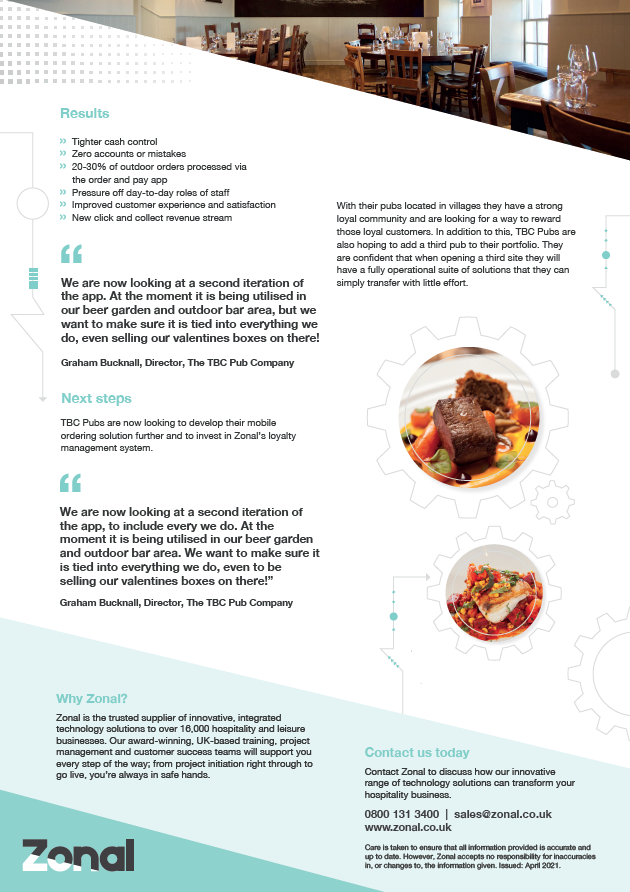
“Zonal’s back-office system is simple and intuitive for our front-of-house staff to use and has brought in tighter cash control – exactly what you’re looking for as owners of the business.”Graham Bucknall, Director, The TBC Pub Company
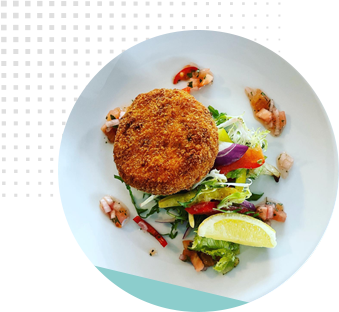
TBC Pubs invested in Zonal’s core EPoS solution to begin with. Having heard good things from previous users, they trialled a few systems and settled on Zonal. Since then, they have also adopted Zonal’s integrated payment solution, Order & Pay, Click & Collect, online bookings and table management, and our property management system, High Level Software.
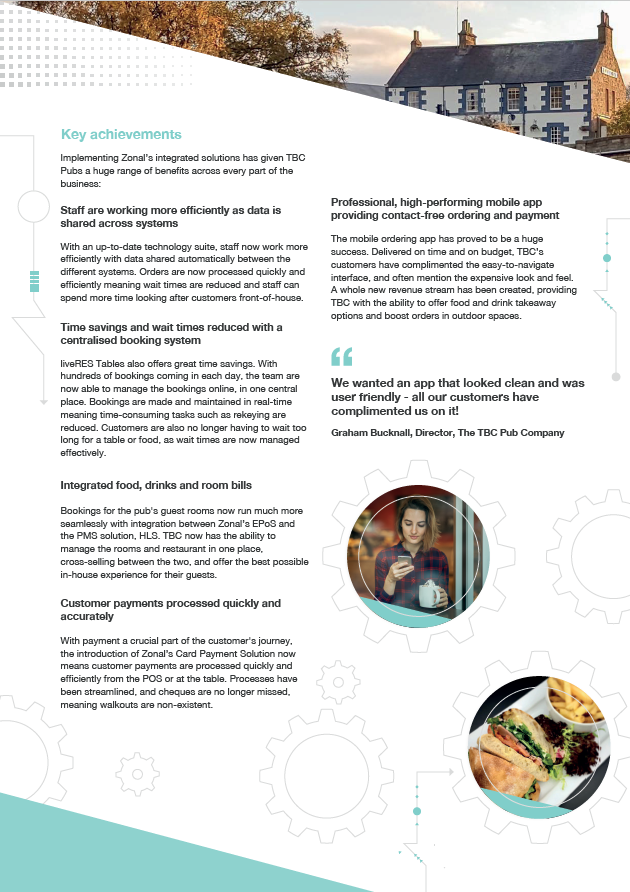
“When compared to other apps, we found Zonal’s to be much cleaner and easier to navigate; we found the cheaper apps didn’t look as professional, with only basic branding and customisation options. Our customers often say it looks like we built it ourselves, it looks and feels expensive!”Graham Bucknall, Director, The TBC Pub Company
Implementing Zonal’s integrated solutions has given TBC Pubs a huge range of benefits across every level of the business.





Amidst a challenging trading environment for pubs, many operators will be looking to use every tool at their disposal to help them better navigate rising costs, protect their margins, drive revenue and enable their team to achieve more.
Powerful pub tech, which has previously only been seen as viable for the big brands is now more accessible than ever, and the value it can add for smaller businesses – from independent village pubs to groups with aspirations for growth – has never been more apparent. In this guide, we explore the different solutions available to pub operators, and how this technology can help pubs meet their objectives.


Guides
The Loyalty Landscape


Research
GO Technology: The social value of hospitality

Webinars & podcasts
People Make The Experience: How Your Staff Drive Customer Loyalty

Webinars & podcasts
It Should Feel Like Magic, Not Marketing: Personalisation, Loyalty & Data in Hospitality

Webinars & podcasts
Loyalty That Lasts: Growing with Guests, Not Just Points

Webinars & podcasts
What Diners Want: The New Rules of Loyalty in Hospitality


Blog
How hospitality businesses can create ‘Superfans’

Blog
How loyalty can help tackle no shows

Technology continues to play a vital role in the running of a restaurant business. With consumer demands always changing, many technologies previously associated with larger restaurant groups have become widely adopted, enabling restaurants of all sizes to meet these ever-changing consumer expectations, as well as navigate the challenges faced by hospitality in the current trading environment.
In this guide, we explore some of the different technology restaurant operators should be considering implementing into their venues, the benefits these solutions bring to the table, and the importance of choosing the right tech partner to work with when considering a new system.


Guides
The Loyalty Landscape
Research
GO Technology: The social value of hospitality
Webinars & podcasts
People Make The Experience: How Your Staff Drive Customer Loyalty
Webinars & podcasts
It Should Feel Like Magic, Not Marketing: Personalisation, Loyalty & Data in Hospitality
Webinars & podcasts
Loyalty That Lasts: Growing with Guests, Not Just Points
Webinars & podcasts
What Diners Want: The New Rules of Loyalty in Hospitality
Blog
How hospitality businesses can create ‘Superfans’
Blog
How loyalty can help tackle no shows
Growth is a natural sign that a business is doing something right: it shows that there’s a demand for what you do, and that’s why your customers keep on coming back.
However, growth needs to be approached with a degree of caution. There’s the danger that your business can grow too quickly, or even grow in the wrong ways.
That’s why you need the right tools. That means leveraging the power of the data your business already generates, but which you might not currently be able to access. It means streamlining what you do, reducing complexity and operating costs, enabling your staff to deliver exceptional customer service.
Download our Growing your hospitality business guide to find out more about:
These are tough times for the hospitality sector. We all know the factors: rising costs resulting in narrowing margins, while increased customer expectations are demanding continuous change and improvements.
And we know that some businesses respond by trying to work harder instead of smarter, pushing already stressed staff to breaking point or beyond. That rarely ends well, and it rarely delivers customer delight. There’s a better way, and that’s to do what you already do – but better.
All you need to do is unlock the power of the data your business already generates. The results can be extraordinary. At liveRES we’ve spent many years helping hospitality businesses big and small enjoy greater revenue and increased profits. And a huge part of that success is made possible by using integrated technology to share critical data.
Download our Fulfilling your profitability potential guide to find out more about: