


-

Guides
The Loyalty Landscape
Running pre-order menus during the festive period offers several benefits, including streamlined operations, better inventory management, and enhanced customer satisfaction.
By allowing guests to place orders in advance, you can accurately gauge demand, reduce potential food waste, and ensure your team have the necessary stock on hand. This approach also helps alleviate last minute rushes, allowing your staff to focus on providing quality service and creating a more organised dining experience.
Pre-orders can be set up to send to the POS and to the Kitchen in 3 different ways:
Pre-orders will attempt to send order to the site POS from 4am on the dining date of the booking
All pre-orders will display on the POS with a pickup time of 23:59
Pre-orders will automatically send to kitchen 5 minutes before pickup time set above (23:54) unless manual intervention has happened. If no manual intervention happens the order will be sent to the kitchen without a table number. This is why we recommend this pickup time being set to 23:59 to prevent orders sending directly to the kitchen without Tables Numbers.
Checking your pre-orders have been sent correctly from the Events
Host platform
Log onto the Host platform and select the Day Diary tab to display all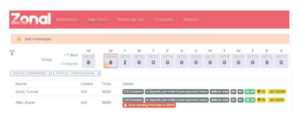 bookings for the day. Any pre-order sending errors will appear in red – in the example it states, “Error sending PreOrder to EPOS”.
To troubleshoot any errors, navigate to the Chef Reports on the Reports tab. Using the date range selector, amend the start and end date to the current day. All pre-orders will display.
In the example on the right, using the Event view of the report, users are presented clearly with the reason for a pre-order not sending.
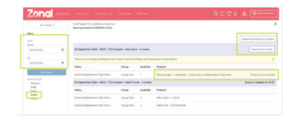
For this example, the error is an item out of stock. To resolve this error, the item will need to be placed back in stock on the POS. Once this is done, select “Resend pre-order” on the Chef Report.
Ensuring the kitchen team have the Chef Report
Once all errors have been resolved, ensure the kitchen team have a copy of the Chef Report (we recommend using the report stating number of items per event), which can be printed from the Host app. This way they can prepare large orders in advance. Automated emails containing the Chef Report can also trigger emails to desired recipient(s) daily.
Check the pre-orders on the POS
Once a pre-order reaches the POS, they are stored on the till as delayed orders.
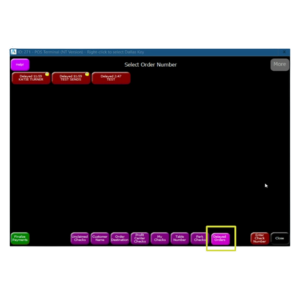
To view the orders, navigate to Pick up Account on the till (often found in Options). This will display all open accounts within the sales area.
Use filtering at the bottom of the screen to display only Delayed Orders. If the venue as multiple sales areas, it is recommended that the Sales Area Account filter is deselected to show all orders across the venue.
Ensure all bookings that have a successful pre-order are displayed. Please note additional orders may display if using delayed ordering for other elements.
Ensure your FOH team have either the Chef Report or Run Sheet
Run Sheets are part of a “Central Reservations” feature flag in the system. If you do not see this option within your setup, you may need to speak to your account manager.
To access the Run Sheet, open the booking on the Host platform, scroll towards the bottom and select Generate Run Sheet. Click the desired options and “generate”. Once loaded, print.
Now that you are prepared with your morning tasks, it’s time for the guests to arrive. The below steps offer a walkthrough of the recommended steps for handling bookings once guests have arrived at the venue.
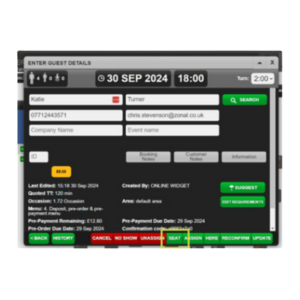
Once the booking has arrived and the guests are ready to go to their table, seat the guest on the Host platform.
If the booking has a deposit paid, the Redeem Deposit box will display. Use the Seat & Redeem button to add the deposit to the table on the POS (if the option does not display, please speak to your account representative who will be able to enable this feature for you).
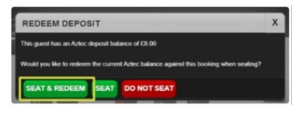
Once completed, the table will be opened on POS with the booking name and deposit applied.
Once all the guests have arrived and are seated, using the Chef Report or Run Sheet, users are recommended to confirm all pre-ordered items are correct with the guests.
Log on to the till and navigate to delayed orders (found in Pick Up Account usually in Options, use filtering to display delayed orders only).
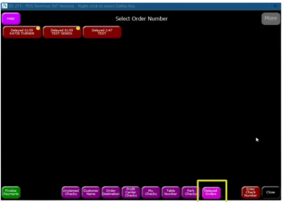
Select the correct delayed order (pre-order).
The order preparation prompt is then displayed asking if you wish to start preparing the order. It is important that you select ‘No’ so that you can assign the pre-order to a table. If yes is selected, this will send the pre-order straight to the kitchen without a table number.
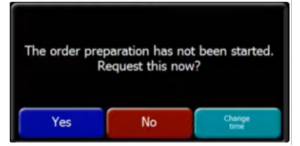
Selecting no will open the order on to the Order Pad.
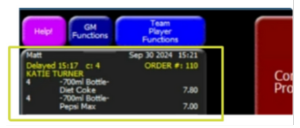
Add the order to the table where the booking is seated by opening the table plan on the POS and selecting the correct table. In the below example the ‘Tables’ button is selected to open the table plan; this may be worded differently in different estates.
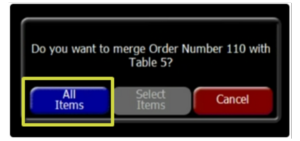
A box will display asking “Do you want to merge Order Number X with Table X?”, select All Items to add all pre-order products to the table. Once added to the table, make any required changes from the checks done in step 2.
On completion, click Save and this will send the finalised order to the kitchen,
We highly recommend that you test this journey, end to end before your busy period hits.
Zonal’s Customer Success team is on hand to carry out a Booking Health Check which is available exclusively for Zonal customers to ensure you are getting the most out of your Zonal technology.

Products and Solutions Consultant at Zonal
Alan is a Products and Solutions Consultant at Zonal with 17 years’ experience working in the hospitality sector in multiple roles, from bartender to General Manager. He is responsible for helping our customers to get the best from our booking platforms, as well as our White Label App and Web Ordering products.

What with Wagamama and Mowgli recently launching loyalty schemes, Deliveroo investing in an advertising campaign to promote its Deliveroo Plus scheme this autumn and the news earlier this year that Pret A Manger was to ditch its much-feted subscription model, customer loyalty is a hot topic in hospitality right now.
But I don’t believe customer loyalty exists. Recently, I was approached by hospitality tech firm Zonal to see if I’d like to work with it on a project around this very subject. I started by telling a story about my love for Honest Burgers. We have an Honest Burgers right opposite our office. In fact, if the fire alarm goes off, it’s our designated meeting point. We have a lot of fire drills.
I loved going in there. The staff were friendly, the music was perfect, and it had plants everywhere that gave a really nice feel to the place. And I had a rather specific, rather odd order. I liked to have the plant burger, but I really like bacon, so I’d always add some of that on top, too. The vegan plus meat combination could have easily been a cause for confusion, but rather than causing issues, it simply became: “Would you like the usual, sir?”
Then, near Christmas, the manager of that restaurant left to go elsewhere. And when I next went in, everything had changed. The staff were still lovely, but the music had changed. She chose the playlists, apparently. The plants were all gone – also hers, brought in from home. And, when I put in my usual order, the waiter reappeared ten minutes later with a question from the chef: “Sir, just to check, did you really mean real bacon with that?”
Loyalty is an overused term in organisations and hospitality, and it’s a dangerous one. Because if leaders believe their customers are loyal they stop trying to impress them, focusing on winning them in the first place, then gradually taking their custom for granted.
Quite simply, if you stay more useful to your customers than the competitors and alternatives, your customers will stay with you. But if someone else becomes more useful – a better product, better price, better experience, more socially desirable brand – then they’ll go elsewhere. But where you can build some sense of loyalty is through your people – as Octopus, AO and First Direct show.
Octopus Energy is taking the highly regulated energy industry by storm by empowering its team to come up with creative ways to solve its customers’ problems. Customers hated the hold music, and so now, should you be put on hold by Octopus, you’ll hear a song from the year you turned 14 – the age that, on average, a person first engages with music. Another example is the Octopus Wheel of Fortune. Every time an Octopus customer enters a meter reading, they can spin the “wheel of fortune” to win anything from 1p to £512 credit on their account, and more than 100,000 of them a month do so. This shows an understanding of the inconvenience of submitting meter readings for customers and actively recognising and rewarding them for doing so.
Another industry you may not think to look at for loyal customers is white goods, but online retailer AO is one of the highest rated UK retailers of any kind on Trustpilot. That’s in no small part down to the fact that one of its core values is: “Treat every customer like your own gran.” But, more than this, staff are supported to deliver on this promise. Stories are manifold, from delivery drivers paying for pizzas when a new oven can’t be fitted in time for dinner to local teams arranging for an AO branded van to visit a six-year-old van fan on his birthday.
Likewise, banks are about as well known for building loyalty among customers as utility firms and white goods retailers, but talk to any customer of First Direct and most will extoll its virtues. Again, this is down to first-class customer service delivered by teams supported to do so. First Direct famously “hires for the smile, trains for skill”, and then enables its teams to listen to customers and act with empathy – no scripts, no call handling time targets and calls answered by real people.
The hospitality industry has a huge advantage over others in this, as a people-focused sector with colleagues who know that customer experience is crucial to delivering a great experience. There are other complexities to this, of course (the ambition of the leadership to provide excellent customer experiences, great training, a fundamental understanding of what drives your customers’ decision making, a recognition that not everything in good business must deliver an immediate return on investment).
However, while I maintain that customers are not loyal to businesses, I do believe they are loyal to other people – and these can be your people, assuming you give them the correct support and tools.

Managing Partner at The Foundation
John Sills is the author of Leadership Book of the Year 2023, The Human Experience and Managing Partner at customer-led growth consultancy, The Foundation.
Guest blog by Net Zero Now
The climate crisis is no longer a distant threat but is already having a very real impact on the hospitality industry. That impact is both direct, resulting in increased costs as supply chains are put under increasing pressure and the cost of energy increases, and indirect, driving new attitudes and expectations of customers, employees, and investors.
But with these challenges come opportunities – to improve your bottom line, to establish yourself as a leader in an increasingly eco-conscious market and to increase the value of your business.
The hospitality industry is uniquely vulnerable to the effects of climate change. Rising temperatures, extreme weather events, and shifts in global ecosystems directly affect the supply chains that businesses rely on, resulting in higher costs and lower / less reliable availability.. Energy prices are also likely to soar as demand for cooling increases and fossil fuel resources become scarcer.
Indirectly, the climate crisis is changing the attitudes of the people who make your business thrive – your customers, your employees and your investors.
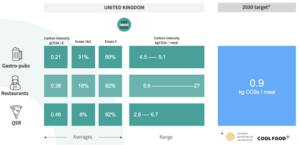
Businesses also face increased regulatory pressure. In the UK, larger businesses (£36m+ t’over) are already required to report Scope 1 and 2 emissions under the Streamlined Energy and Carbon Reporting (SECR) regulations. These requirements are expected to expand in the near future, reducing the threshold to include more businesses and increasing the reporting requirements to include Scope 3 emissions (the emissions from your supply chain, including all the food and drink you buy throughout the year). This is particularly relevant to the hospitality sector which contributes up to 15% of the country’s greenhouse gas emissions (Net Zero Now, 2024, and where Scope 3 emissions account for c.70-95% of emissions, the vast majority of which comes from the food served (see Figure 1).
Figure 1: Emissions Sources from different types of hospitality business
Source: Net Zero Now Customer analysis; Cool Food 2022
As Figure 1 also shows, as an industry, we have a long way to go to meet the 2030 targets for carbon emissions per meal. Getting anywhere near these targets will take more than removing plastic straws and adding a few LED lightbulbs, hospitality businesses need to understand their full carbon footprint, including Scope 3 emissions, and find ways to minimise their climate impact.
I know what you’re thinking – “it’s too expensive”, “it’s too complicated”, “we’re too busy” – and until recently, you might have been right. But…
and , as if all of the above wasn’t enough
Ready to turn the climate challenge into a business opportunity? Discover how Net Zero Now’s integration with Zonal can help you accurately measure, manage, and reduce your carbon footprint. Start your journey towards sustainability today—contact the Zonal team and see how we can support your business in leading the way to a net zero future.
Sources:
Christmas is drawing closer and we’re starting to see menus being promoted much more on our social media channels as both consumers and venues start to make their plans for the busy holiday season…
Zonal’s Customer Success team have already been busy working with users of our reservations platform, Zonal Bookings; providing them with guidance and useful tips, as well as showcasing some of the newest functionality which will bring huge benefits to their businesses.
Here are the top 3 topics we’ve talked about with our customers when it comes to Bookings and preparing for Christmas…
When it comes to building Christmas menus, they are usually a set menu, with a set cost.
They can consist of a promotional cost to entice guests to push the boat out that little bit further, upgrading from the usual one course to two, or the two course to three – or even an upsell of a drink.
Set menus also allow venues to simplify their operations – for example streamlining kitchen operations by allowing chefs to prepare a limited number of dishes in larger quantities, helping maintain consistency and speed.
Here is some guidance on how to to set these up in Aztec, iOrder and Bookings, to ensure you get the much needed efficiency across all areas: operations, reporting, staffing and customer engagement.
Creating set menus can require a bit of extra configuration to ensure pricing structures are set up right. We recommend using Promotions when setting them up in Aztec. Within the Promotions wizard in Aztec, users can create Multi Buy promotions and determine rules to these. Outlining rules for these “Groups” and defining the quantity of items to be selected within each group helps ensure any varying portion sizes are recognised.
As well as defining the days/times in which this promotion will be available, you can outline promotions as single rewards e.g., 1 starter, 1 main, 1 dessert = £40. Then when publishing this out to guests in their pre-ordering guest portal, the prices per item can be hidden, to only display the set menu price.
Following a recent feature release of Bookings, you can now preview the menus prior to it being issued out to your customers – you can find out more about this on the Product Portal here.
Deposits, pre-payments or credit card guarantees have become increasingly popular, and necessary, over recent years, as businesses want to secure revenue upfront to manage cash flow and cover rising operating expenses.
With no-shows are also continuing to be a factor impacting sales, deposits, pre-payments or credit card guarantee ensure that you doesn’t lose out entirely if guests cancel late or fail to show up.
In the Zonal world, we define these as “Booking Rules”, and when implemented as part of the guest booking journey, can give businesses the following benefits:
Tailoring your guest journey has been a hot topic for some time. Creating bespoke journeys by event type offers several important benefits for both business and customer.
For guests, it will ensure a more personalised experience. Providing a journey with specific menus, areas, or upsells that are relevant gets better engagement.
To you, as a business, it will offer higher conversions. Bespoke journeys for events such as Christmas can offer a more direct journey. Reducing booking friction, improving conversion rates and presenting targeted upsell opportunities. Bespoke journeys or widgets can also have referral sources, which help businesses further understand how their guests are hearing about them.
Zonal Bookings features a widget customiser, enabling users to create bespoke journeys, which can be placed in varying locations on your website. Businesses can even place these on hidden pages so when emailing VIP guests, they can send bookers to hidden pages granting them a unique journey or offering.
Watch the video of what’s new in Zonal Bookings in 60 seconds here: Discover what’s new
If you’re coming up against any of these topics, or wanting to discuss these in more detail, then get in touch with Zonal’s dedicated Customer Success team and we’ll be happy to help.

Head of Customer Success at Zonal at Zonal
Natalie is the Head of Customer Success at Zonal. Having worked in the hospitality sector for 17 years, in roles ranging from front of house, business development, event co-ordination and leading a project team, it brings an understanding of how various teams operate. Specialising in Bookings, Natalie is passionate at ensuring users get the most out their systems and ultimately driving operational efficiency as well as bottom line. In her spare time, Natalie is on the management committee of a Community Owned Pub in North Wales, which brings with it a wealth of knowledge in experiencing the day to day issues and challenges faced within a business.

The latest figures from Zonal show reservations for the month of December are already up by over 40% on 2022, and that bookings for Christmas Day itself are up a whopping 59%, suggesting that despite the cost-of-living-crisis, the crucial festive season is looking positive for the hospitality sector.
Effective from October 1st, 2024, the Fair Tipping Act aims to ensure that all tips left by customers reach workers, and that the allocation of these tips is distributed fairly. The Act primarily covers “employer-received” tips, including non-cash and cash gratuities that an employer has control or direction over.
Our partner, TiPJAR has created a useful guide outlining an 8-step process in achieving compliance with the new legislation, starting with creating, communicating and implementing a tipping policy.
But what does this mean for managing cash tips? We have put together a short, step by step guide to help you manage your cash tips in Aztec using the Finance Module:
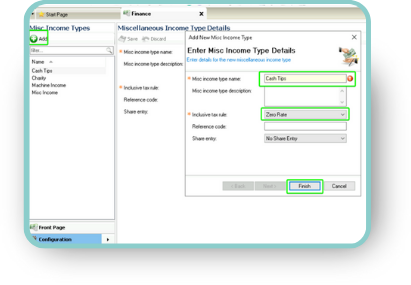
6. Navigate to Estate Settings in the Finance Module
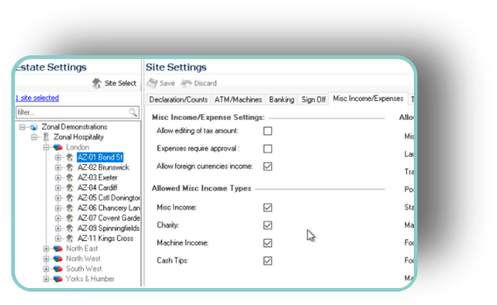
7. Select the site (or multiple sites using ‘Site Select’) who will be using the Cash Tips income type
8. Select the Misc Income/Expenses tab and enable Cash Tips by ticking the associated box
9. These changes can now be sent to sites via the Communications module in the usual way
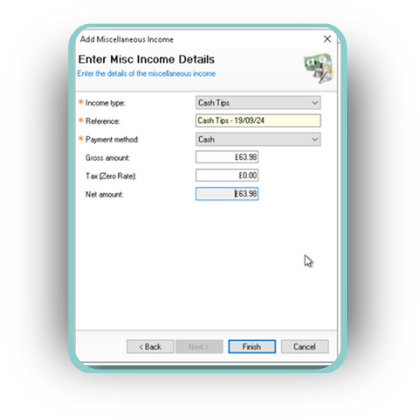
6. Cash is selected in the Payment Method dropdown box.
7. Add in the total amount of cash tips and select Finish.
8. Cash tips have now been recorded and will be now included in your cash on site total when completing the end of night reconciliation.
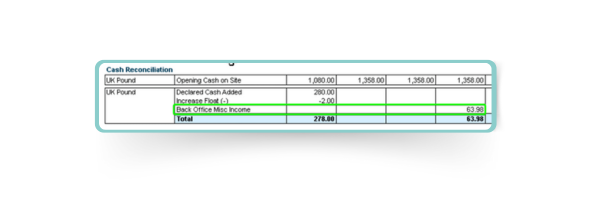
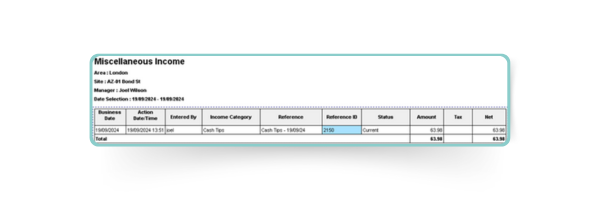
9. The cash tips will be visible on the 7 Day Statement of Trade under the Cash Reconciliation section or use the Misc. Income Report if more granular detail is required.
We’ve compiled the most common support queries our users face including tips on how to resolve them as quickly and efficiently as possible.
Card-related issues are typically resolved by our payment partner, JudoPay and to expedite the process you can reach out to them directly using the following details:
Email: support@judopayments.com (copy us at support@zonal.co.uk so we can keep an eye on the situation)
Phone: 0333 2341210
Tip: Check JudoPay’s status page for global issues.
When reaching out, please include the following details to help speed up the process:
Need to make bulk updates? We’ve got you covered. Head to our eLearning Centre for step-by-step guidance on stopping sales and managing inventory changes.
Need to split a booking or handle group reservations? Find all the information you need in our eLearning Centre under Training Videos, Training Documentation, or our FAQs section.
Looking for help with ledgers and reports? You can find step-by-step guides and training videos in our eLearning Centre.
We offer in-house or virtual training sessions to guide you through mapping new rates. Contact your account manager for more information.
Prefer we handle it? No problem! Just send us any relevant screenshots or rate details from third-party sources, and we’ll assist you promptly.
Learn how to manage bookings directly through the calendar in our eLearning Centre.
Did you make a mistake with a booking? No worries! Visit our eLearning Centre to learn how to undo incorrect check-ins.
Reservation failures can occur for a variety of reasons. Here’s how to troubleshoot:
This is to maintain data integrity, past blocks can’t be deleted. Learn more about blocks in our eLearning Centre.
Ready to set up a new rate? Follow the simple steps outlined in our eLearning Centre to get started.
For more information or assistance with any of these topics, don’t hesitate to reach out. We’re here to ensure everything runs smoothly!
NB: If you are struggling to find the support article in our eLearning Centre, get in touch and we will direct you to the most appropriate resource.


Guest blog by RevenueRich
With a new government in power, continued pressure on household finances and cooler-than-average temperatures to contend with, it’s safe to say that it hasn’t been the easiest summer for the UK hospitality industry. As the low season approaches for many of us, it could be an uncertain outlook for hoteliers, but with savvy use of the right technology, there is a plethora of ways to weather the storm and boost profits over the coming months.
Here, RevenueRich, a consultancy specialising in commercial revenue management, pricing, distribution and analytics for the hospitality industry, gives a quick guide on some of the commercial strategies that are most effective during the quieter months of the year.
Stay ahead of your competitors by planning packages to excite and entice new guests at the times you need, well in advance.
Make the best use of your hotel’s facilities, include exclusive discounts and offers and communicate these clearly through collaborative teamwork across your sales, marketing, and revenue management functions; isolated activity rarely yields the best results.
Sell the right rooms, to the right people, at the right price! Extend your reach during periods of low demand by engaging with distribution partners, affiliations and Global Distribution Systems (GDS).
These platforms open doors to thousands of potential booking opportunities from online travel agencies, leisure agents, travel management companies and corporate travel departments looking for flights, transfers and places to stay.
Prices and packages can be adjusted to drive occupancy and total sales based on historical data and current trends, to help hoteliers maximise their profits.
Alongside this, revenue management software can support pricing decisions in near real-time using your hotel’s performance trends and local market competitor data.
Take control of your pricing to boost sales and avoid loss-making promotions. Ensure your rates are set correctly for autumn, winter and beyond by using revenue management systems and techniques with competitor demand and pricing insights.
Make practical decisions and see what does and does not work for your hotel by reviewing your data. Detailed reporting will allow your team to analyse trends, compare data from years gone by and make future forecasts for the low season ahead.
Data collected from your hotel PMS software, revenue management software, and market data sets will help you to create comprehensive weekly /monthly reports with strategic comparisons for planning.
Don’t wait too long to react, make it happen! As we said above, planning is key – find the right software and expertise for your hotel, embrace the technology and get your revenue management systems and processes in place with plenty of time before the nights draw in and demand slows.
It’s no secret that tech now plays a crucial role in business growth for hotels. In fact, revenue management techniques and technology combined can grow sales on average between 5% – 17%.
With their expert knowledge, RevenueRich can help you to shop around and explore the various revenue management systems on offer before selecting the right software for your hotel, team and guests.
With over 45 years of collective industry experience, the team put revenue management, pricing, distribution and analytics at the heart of its approach, to help grow your bottom-line profit.
 |
To find out more about RevenueRich visit our website or call 07709 321 237 to talk to a member of the team about how they could help your hotel. |
A landmark debate in September at the House of Commons is set to change the face of venue safety laws in the UK.
The Terrorism Protection of Premises Bill or ‘Martyn’s Law’ was discussed by MPs in September; an anti-terrorism bill in memory of 29-year-old Martyn Hett, who was killed alongside 21 others in the 2017 Manchester Arena bombing. The law is currently under review by the Public Bill Committee and is set to come into action over the coming weeks.
The main aim of the Bill is to protect the public from the impact of terrorist attacks and to prevent physical harm. It comes after the terror threat for venues in the UK has been described as ‘substantial’ by officials, who have revealed that 43 terrorist plots have been foiled since 2017.
Mainly aimed at concert halls, stadiums and other crowded venues, Martyn’s Law outlines new specific safety measures for most public venues based on different capacities, meaning hotels and other hospitality venues will be affected when the law becomes official.
The Law calls for mandatory safety training and ‘practicable public protection procedures’ in venues with a capacity of 200 – 799 (known as standard tier and raised from 100 in September to create a more appropriate scope of duty).
Whereas in larger venues with a capacity of over 800 (enhanced tier), more rigorous measures are required such as additional security staff and minimum CCTV requirements.
Martyn’s Law will have large implications on the hospitality industry, however, many hospitality providers are clearly seeing the benefit to public safety, with 100 venues publicly backing the bill, including McDonalds.
Since we last talked about Martyn’s Law in February of this year, there have been some adjustments to the proposed requirements. Here we discuss the biggest changes for hotels and other hospitality providers to help you prepare for the new legislation.
There is a focus on practical and effective safety training to prepare for a terrorist event, including practice runs by team members.
Since the bill was first proposed, the requirements for training have become more prescriptive and involve safety procedures for the following:
This more active approach aims to raise and maintain awareness of anti-terror measures amongst hotel staff so they can be implemented effectively in the event of a terror attack.
A ‘responsible person’ will implement these measures and ensure adequate training takes place and all safety measures should be clearly communicated with the regulator.
In summary, since the Government consultation on Martyn’s Law, there is now less emphasis on paperwork and a greater focus on ensuring that all your employees fully understand how to deliver the anti-terrorism measures to reduce physical harm.
The government hopes that these requirements will enable venues to tailor their measures to suit their operational needs.
If your hotel or venue falls into the Enhanced Tier category, regulators will need to be informed of any events where 800 or more individuals are attending your event.
The same safety training and actionable public safety procedures apply here as for Standard Tier venues; however, paperwork requirements are more rigorous and all safety measures in place must be adequately documented as proof of compliance. This will also include safety assessments of the efficiency of your hotel’s safety measures.
As with standard tier requirements, there must be a ‘responsible person’ in charge of implementing these measures. However, if your hotel or venue falls under the 800 capacity tier, a ‘senior’ responsible person must be nominated for each event where there are 800 or more individuals attending.
As well as the hotel itself, the surrounding area must be monitored for suspicious activity by using additional staff and/or extra CCTV.
There will be an expected grace period of around 24 months to enable venues to put these plans into place before the Security Industry Authority (SIA) begins regulatory action to enforce the law.
The SIA will have the power to issue compliance notices, limit operations and give out hefty fines to venues of up to 5% of worldwide revenue (AEO) for those who don’t comply. This figure could be in the millions for multi-site hotel chains or venues.
With this in mind, and the bill currently making its way through Parliament, now is the time to get your anti-terrorism measures in place to ensure the safety of your customers and guarantee your venue is compliant.
Guides
The Loyalty Landscape


Research
GO Technology: The social value of hospitality

Webinars & podcasts
People Make The Experience: How Your Staff Drive Customer Loyalty

Webinars & podcasts
It Should Feel Like Magic, Not Marketing: Personalisation, Loyalty & Data in Hospitality

Webinars & podcasts
Loyalty That Lasts: Growing with Guests, Not Just Points

Webinars & podcasts
What Diners Want: The New Rules of Loyalty in Hospitality


Blog
How hospitality businesses can create ‘Superfans’

Blog
How loyalty can help tackle no shows
Freshers’ week is fast approaching, to help you navigate this busy period and make sure you’re getting the most out of your Zonal system, we’ve created 6 top tips all aimed at helping you achieve their business goals, and ensure everything in-venue runs as smoothly as possible:
Loyalty platforms help to encourage repeat customers, while also collecting data to promote new products, promotions and even venues. Multiple loyalty programmes can be created within our platform to benefit students. More importantly, loyalty programmes help to drive sales and footfall into venues. Each programme can be configured with different offers and rules providing a tailored approach to each target audience.
Actions and Rewards can be set up to work across the whole estate, alternatively, they can be limited to specific sites within the university areas as well as helping to drive sales towards an area of the business that might be struggling.
Multiple tiers can be set up to target specific societies within a university. By offering unique loyalty programmes and rewards to a society, this can help target specific days when they train or gather, and in return help drive trade for quieter periods.
An attractive sign-up offer can go a long way to a successful launch of a loyalty programmes. This can either be a free item for registration or additional currency/points being collected and redeemed per purchase. Points and Currency rewards can be delayed to the following day after sign-up. Aswell as delaying the reward, an expiry can be set. This helps target return footfall and spend in a short period.
Points for spend schemes are a fantastic way to encourage and promote spending in venue. Points accrued can be then exchanged for items or converted into currency to spend, providing students with something tangible to aim for. Double point offers can also be applied to specific sites at specific times to help drive sales during quieter times.
Due to the nature of the sales being very term time led, this can lead to items perishing resulting in increased waste. If there are specific items that are going out of date after the term, rewards can be created to increase interest and help these items sell.
The hospitality sector can be prone to high staff turnover, city and university-based venues that typically hire students will no doubt be used to this. Introducing a staff loyalty programme can help retain staff as well prevent the abuse of staff discounts.
All staff discounts can be hidden from a till user, and only be allocated to a bill when a staff loyalty card is scanned. Staff loyalty schemes encourage their spending to be done within the estate rather than with competitors. Loyalty rewards such a buy 5 coffee and get a 6th coffee free can help to encourage this.
Loyalty Programmes rely on students signing up to receive rewards or discount. However, Voucher Manager can provide an alternative solution to encourage students into your venues over a competitor.
Social media campaigns can contain a voucher code with a discount or promotion. This code created via our Voucher Manager solution and can be used by multiple customers. To redeem this, staff simply need to scan the code at the POS to apply the discount or promotional offer, removing any reliance on emails or sign up. Voucher Codes can also be printed on flyers and posters and distributed to students. Using the redemption data, code groups and folders, these vouchers are easily trackable, this can help you to identify which distribution method works best for your customer demographic, helping you to identify and utilise your optimal marketing channels.
Voucher Manager can also integrate into a CRM platform, enabling you to distribute unique codes to existing customers within the database. This will provide a unique identity on redemption and therefore improve your understanding of your customers spending habits. Within Voucher Manager, restrictions can be made on redemption date and time. For example, 2-4-1 cocktails before 9pm on Friday, helping to ensure maximum spend and increased venue during those busier periods.
As well as creating codes, Voucher Manager can be loaded with pre-defined codes with the discount or promotion assigned to them. An example of this is to upload Student IDs into Voucher Manager and configure a 10% off discount to these IDs codes. The student can then simply provide the site with their unique ID and receive their discounts, depending on your offer the discount can then be configured to be a one-off usage or allow for multiple redemptions.
Event Pricing in Zonal’s EPoS allows POS users to change the pricing of products. This is typically used to increase prices during busy periods, for example a Freshers Event or after a specified time. Overall, helping to maximise profit during your busiest periods.
Students are a perfect demographic for Order & Pay, Click & Collect or Pay My Bill. These ordering channels help free up staff time and assist with operational processes in venue. It is also possible for customers to redeem loyalty points, vouchers, discounts & promotions within our Web Ordering platform and on our White Label App.
Get in touch today and our team of hospitality technology experts will be happy to talk you through what’s possible.

Customer Success Consultant at Zonal
Katie is part of the Customer Success Team working closely with multiple departments within Zonal to ensure customers are using our technology to drive retention and revenue into their business. Katie’s background is working within the hospitality industry, with a keen focus on Marketing.
In an era where hospitality standards define visitor experiences, the importance of ensuring quality standards is paramount. As a result, the free Visitor Ready Digital Accreditation Scheme was born – an essential benchmark for excellence that aims to elevate hospitality standards to new heights.
The scheme empowers UK hospitality businesses to demonstrate their commitment to operating safely within current industry standards and legislation. What’s more, it’s more than just a compliance tool, it equips establishments with the knowledge to meet today’s expectations for safety and cleanliness.
With consumers becoming more selective over where they choose to visit, demonstrating a commitment to safety, ethical practices, and cleanliness has become essential for businesses in the industry. In response, the Visitor Ready Digital Accreditation Scheme was launched. This initiative, introduced in February 2024, offers hotels, restaurants, tourist attractions, and transportation services a free and pioneering opportunity to elevate the visitor experience within the hospitality sector.
The scheme stems from the modernisation and simplification of quality assessment frameworks previously utilised by the AA and VisitEngland. By making compliance accessible to all businesses in hospitality, it aims to ensure that establishments meet and exceed current industry standards. This strategic initiative not only boosts confidence among visitors but also supports businesses in maintaining high operational standards and fostering trust within their communities.
The Visitor Ready Digital Accreditation Scheme marks a significant step forward in ensuring excellence within the UK hospitality sector.
By embracing accreditation, hoteliers not only meet regulatory requirements but also cater to the expectations of today’s informed and more selective guests.
As the scheme continues to evolve and expand, it promises to set a new standard for hospitality excellence, fostering trust, satisfaction, and growth across the industry.