If you’ve ever wondered how travel agencies, travel management companies, and even your corporate travel department find the best deals on flights, hotels, and car hire, the answer likely lies in a Global Distribution System (GDS).
But what exactly is a GDS, how does it work and how can it benefit your hotel? If you’re new to GDS software, then we’ve got you covered. This guide will break it down for you and provide five compelling reasons why connecting to these systems can be a lucrative additional revenue stream.
What is a Global Distribution System (GDS)?
Think of a Global Distribution System (GDS) as the backbone of the travel industry. It’s essentially a massive database that contains information about flights, hotel rooms, car hire, and other travel-related services. But it’s not just a static database – it’s a dynamic platform that allows travel providers to search, compare, and book travel products in real time.
Who uses GDS software?
Travel agencies, Travel Management Companies (TMCs), and corporate travel departments all utilise GDS software to secure the best possible rates for their clients or staff.
By leveraging GDS, these organisations can compare prices availability, and booking options efficiently, ensuring cost-effective and convenient travel arrangements.
How does a GDS software work?
GDS works by connecting travel services, such as airlines, hotels, and car hire companies, with travel providers. It aggregates real-time data on availability, pricing, and schedules, allowing users to search, compare, and book travel services seamlessly.
GDS operates as a centralised database that facilitates transactions between travel industry players, ensuring accurate and up-to-date information is accessible, thereby streamlining the booking process and optimising travel arrangements.
Five compelling reasons hotels connect to GDS platforms
#1. Access to a wide distribution network
Connecting to a GDS opens your hotel to a vast network of 750,000 travel agents, TMCs, online booking platforms, and corporate clients, expanding your reach, visibility, and potential customer base.
#2. Efficient inventory management
GDS platforms offer tools for centralised inventory management, making it easier to manage room availability, rates, and restrictions across multiple distribution channels.
#4. Dynamic pricing
GDS platforms allow for dynamic pricing strategies, enabling hotels to adjust rates based on demand, market trends, and competitor pricing to maximise revenue potential.
#4. Access to data insights
GDS platforms provide valuable analytics and reporting tools, offering insights into booking patterns, guest demographics, and market trends, which can inform strategic decision-making and marketing efforts.
#5. Competitive Advantage
By connecting to a GDS, hotels can gain a competitive edge by reaching new markets, attracting more guests, and optimising revenue potential in the highly competitive travel industry.
GDS Vs OTA Bookings
OTAs, such as Expedia and Booking.com, provide a user-friendly platform for consumers to search, compare, and book travel services directly online.
In contrast, GDS platforms act as intermediaries that connect travel service providers with travel agencies, TMCs, and corporate travel departments, offering comprehensive access to travel data and booking capabilities.
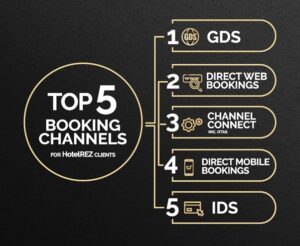
OTAs undoubtedly play a significant role in driving bookings, but overlooking the potential of the corporate travel segment can be a missed opportunity. And with GDS being in the top five revenue-generating channels in the UK, maintaining a diverse channel mix that includes both OTAs and GDS is key to optimising your property’s visibility and increasing direct bookings.
Choosing the right GDS provider for your hotel
Choosing a provider for GDS distribution is a crucial decision for hotels seeking to maximise their reach and revenue potential.
HotelREZ a High Level integration partner, stands out as a leading SaaS-enabled company for accommodation providers, offering comprehensive solutions to more than 2,500 independent hotels, apartments, and hotel groups in more than 100 countries, including private label GDS chain code solutions.
What’s more, its GDS software has an extensive reach, connecting to over 750,000 travel agents, TMCs, or corporate travel departments.
With an impressive portfolio of customers, including renowned names such as StayCity ApartHotels, Dorint Hotels & Resorts, and The Zetter Group, HotelREZ has established itself as a trusted partner in the hospitality industry. Its broad client base underscores the company’s ability to deliver results and support the unique requirements of various hoteliers.
In conclusion, connecting to a GDS can unlock a world of opportunities for hoteliers, offering access to a wider distribution network, increased visibility, and valuable data insights. And embracing HotelREZ GDS as another revenue stream can be a strategic move to drive growth and success in the dynamic travel industry.
To find out more download HotelREZ’s Insights Report or to talk to a member of the HotelREZ team, simply email info@hotelrez.com, and one of their GDS experts will call you back.

case-study
Provenance Inns transforms guest experiences and operations with Zonal PMS
Discover how Provenance Inns utilised Zonal’s connected technology including Zonal PMS, EPoS, and Airship CRM to easily capture and utilise data centrally, enabling them to deliver more effective, targeted marketing to their guests.
Subscribe to get the latest news, product announcements and industry updates
Marketing your hotel's F&B
Download Pete Saunders’ latest presentation on Marketing your F&B to discover effective strategies for maximising the potential of your restaurant, bar, and room service.
In this detailed and insightful presentation, Pete provides expert guidance on:
- Maximising the potential of your restaurant or bar
- Leveraging your room service offering
- Promoting your F&B offerings through various social media platforms
- Implementing innovative loyalty programs and personalised discounts to hotel guests
This presentation walks you through practical hints and tips to enhance your services, as well as discussing various channels to promote F&B offers, loyalty programs, and personalised discounts to guests. By implementing these strategies, you can improve your F&B engagement, boost loyalty, and maximise your hotel’s F&B potential.
Subscribe to get the latest news, product announcements and industry updates
Making the business case to Finance for hospitality technology

Learn more about how specialist hospitality technology can benefit wider stakeholders in your business, such as finance
As an operator working day-in, day-out with your front- and back-of-house teams, you may already be acutely aware of the tangible benefits your technology can offer to your business. However, it can be difficult to “sell” those benefits across for stakeholders within the business that may not be direct users of the technology on a daily basis.
In this guide, we explore how hospitality technology can also meet the needs of your finance team, how the operational improvements it brings can have a positive impact on the wider business, as well as how it can help to deliver more accurate, data-driven insights that facilitate better decision-making to drive the business forward.


Download this guide to discover:
- The benefits of hospitality technology to your wider business
- What key areas will your Finance team consider when implementing new hospitality tech?
- How specialist hospitality technology can meet your head of Finance’s priorities
- How to address any concerns they may have around integration and implementation
Discover more useful resources


Subscribe to get the latest news, product announcements and industry updates
Guide: Transform your hotel's back-of-house operations with hospitality tech
Discover how a suite of connected hospitality technology can help build an efficient back-of-house operation in your hotel
With cutting costs and maximising margins front-of-mind for many hoteliers, ensuring you have the right technology in place to collect, capture and report on operational data from your bar & restaurant is integral to making better, more informed decisions.
Discover how specialist hospitality technology can transform your hotel’s back-of-house F&B operations, from automated and streamlined processes that result in frictionless experiences for guests, to real-time, reliable data collected at every touchpoint within the restaurant that increases reporting accuracy for stock management and business performance to help you cut costs and boost profits.

Download this guide to discover:
- The benefits of specialist hospitality technology in hotels
- How centralised product management improves control
- How stock & ordering technology can help you manage costs and reduce waste
- The role of accurate data in improving back-of-house operations
Discover more resources for hoteliers

tools
Hospitality Tech Assessment: Improving the guest experience & driving loyalty
Answer a few short questions to identify how well your tech helps you to deliver incredible guest experiences that keep your customers coming back time and time again. At the end you’ll get personalised guidance which explains how you can leverage your customer data to offer personalised customer experiences.
Subscribe to get the latest news, product announcements and industry updates
The Hotelier's Guide to Increasing F&B Revenue

Discover how industry-specific technology can help hoteliers maximise their F&B offering and boost revenue
With 57% of consumers stating that an on-site restaurant or bar as a ‘must-have’ amenity when looking to book a stay in a hotel, F&B presents a significant opportunity for hoteliers to drive revenue and increase guest spend. But it’s not just about having F&B on-site, it’s also about delivering great experiences and high-quality food and drink.
In this guide, we explore how you can maximise the appeal of your hotel’s F&B offering and drive revenue, including making the most of the booking journey to increase upselling, catering to guests’ demands for speed and convenience, and leveraging social media as a method of driving footfall.


Download this guide to discover:
- Current hotel hotel consumer trends
- How hoteliers can put F&B on guests’ radar during the booking journey
- The importance of room service and accommodating digital-savvy guests
- How industry-specific hospitality technology can help hoteliers streamline operations and maximise F&B revenues
Discover more resources for hoteliers
Subscribe to get the latest news, product announcements and industry updates
See our connected technology in action
It can be hard to visualise all the different ways connected technology can improve both operations and guest experiences, so we thought we’d show you instead. Click below to explore our connected solutions through the eyes of your customers in our virtual pub, restaurant and hotel, and discover the benefits of integrated hospitality technology at every stage of the customer journey.


Subscribe to get the latest news, product announcements and industry updates
Decoding Hotel Technology Jargon: A Comprehensive Guide
In the ever-evolving landscape of the hospitality industry, technology plays a pivotal role in enhancing guest experiences and streamlining hotel operations. However, navigating through the myriad of technical terms and jargon can be a daunting task.
Our Hotel Technology Jargon Buster is here to unravel the mysteries behind the buzzwords and acronyms commonly used in the world of hotel tech.
Channel Manager
Software that enables hotels to update room availability and rates in real-time across multiple online distribution channels, ensuring consistency and avoiding overbooking.
CRM (Customer Relationship Management)
Strategies, technologies, and practices that hotels use to manage and analyze customer interactions throughout the guest lifecycle, with the goal of improving customer satisfaction and loyalty.
CRMS (Customer Relationship Management System)
Definition: Software that helps hotels manage and analyze customer interactions and data throughout the guest lifecycle to improve customer relationships and drive loyalty.
CRS (Central Reservation System)
A system that allows hotels to manage and distribute room inventory and rates across various distribution channels, including online travel agencies (OTAs) and the hotel’s website.
IBE (Internet Booking Engine)
A tool integrated into a hotel’s website to facilitate direct online bookings by guests.
IoT (Internet of Things)
The interconnection of devices (such as thermostats, lighting, and sensors) embedded with software, enabling them to collect and exchange data, enhancing guest comfort and operational efficiency.
Kitchen Display System (KDS)
KDS streamlines communication between the kitchen and the front of the house, improving order accuracy and kitchen efficiency, enabling operators to do away with paper tickets.
Mobile Room Keys
Mobile apps that allow guests to use their smartphones as room keys, streamlining the check-in and check-out process.
OTA (Online Travel Agency)
Websites and platforms that allow users to book hotel rooms online. Examples include Booking.com, Expedia, and Hotels.com.
PMS (Property Management System)
A centralised software platform that helps hotels manage their daily operations, including reservations, check-ins, check-outs, billing, and room assignments.
POS (Point of Sale) System
Systems that handle transactions between the hotel and guests, including food and beverage purchases, spa services, and other on-site expenses.
Smart Room Technology
Integrating IoT devices and automation to enhance in-room experiences, such as smart lighting, temperature control, and entertainment systems. Immerse guests in a tech-savvy environment with cutting-edge smart room technology.
Table Management System
This system helps hotel restaurants manage reservations, table assignments, and waitlists, optimise seating arrangements and reduce guest waiting times with an intuitive table management system.
Other specialised terms and phrases utilised by professionals in the hotel industry to evaluate hotel performance and effectiveness can sometimes be bewildering. These often revolve around key performance indicators (KPIs) which serve as benchmarks for success. Some of the most common include:
ADR (Average Daily Rate)
The average rate charged per occupied room in a hotel over a specific period, calculated by dividing total room revenue by the total number of occupied rooms.
CPOR (Cost per Occupied Room)
Used in the hotel industry to evaluate operational efficiency and cost management, CPOR represents the total operating costs associated with each room that is occupied by a guest during a specific period.
GOPPAR (Gross Operating Profit per Available Room)
performance metric that evaluates a hotel’s profitability by measuring the gross operating profit generated per available room, calculated by subtracting total operating expenses from total revenue and dividing by the total number of available rooms.
Occupancy Rate
The percentage of available rooms that are occupied during a specific period, calculated by dividing the number of occupied rooms by the total number of available rooms and multiplying by 100.
RevPAR (Revenue per Available Room)
RevPAR is calculated by dividing the total revenue generated by room sales by the total number of available rooms in a given period. It is a crucial indicator of a hotel’s revenue-generating efficiency and helps managers assess pricing strategies, demand trends, and overall performance in comparison to competitors.
Armed with this Hotel Technology Jargon Buster, you’re now equipped to navigate the complexities of the technological landscape within the hospitality industry. As technology continues to advance, staying informed about these terms is crucial for hoteliers looking to provide top-notch guest experiences and optimise their operations.
Embrace the tech revolution and make your hotel a beacon of innovation in the competitive world of hospitality!

blog
Loyalty schemes in hospitality: What top CEOs think
Loyalty is currently a hot topic in the hospitality industry but there remains a lot of confusion. What do consumers mean when they say they are loyal to on-trade brands? Is it the same as for other retail brands? How can the sector create and maintain customer loyalty? Does it genuinely add value to the bottom line – or does it really just boil down to discounting? To answer these – and more – questions, we gathered eight of the industry’s top operators for a chat about all things loyalty.
Influence, loyalty and technology: Key guest trends from 2023
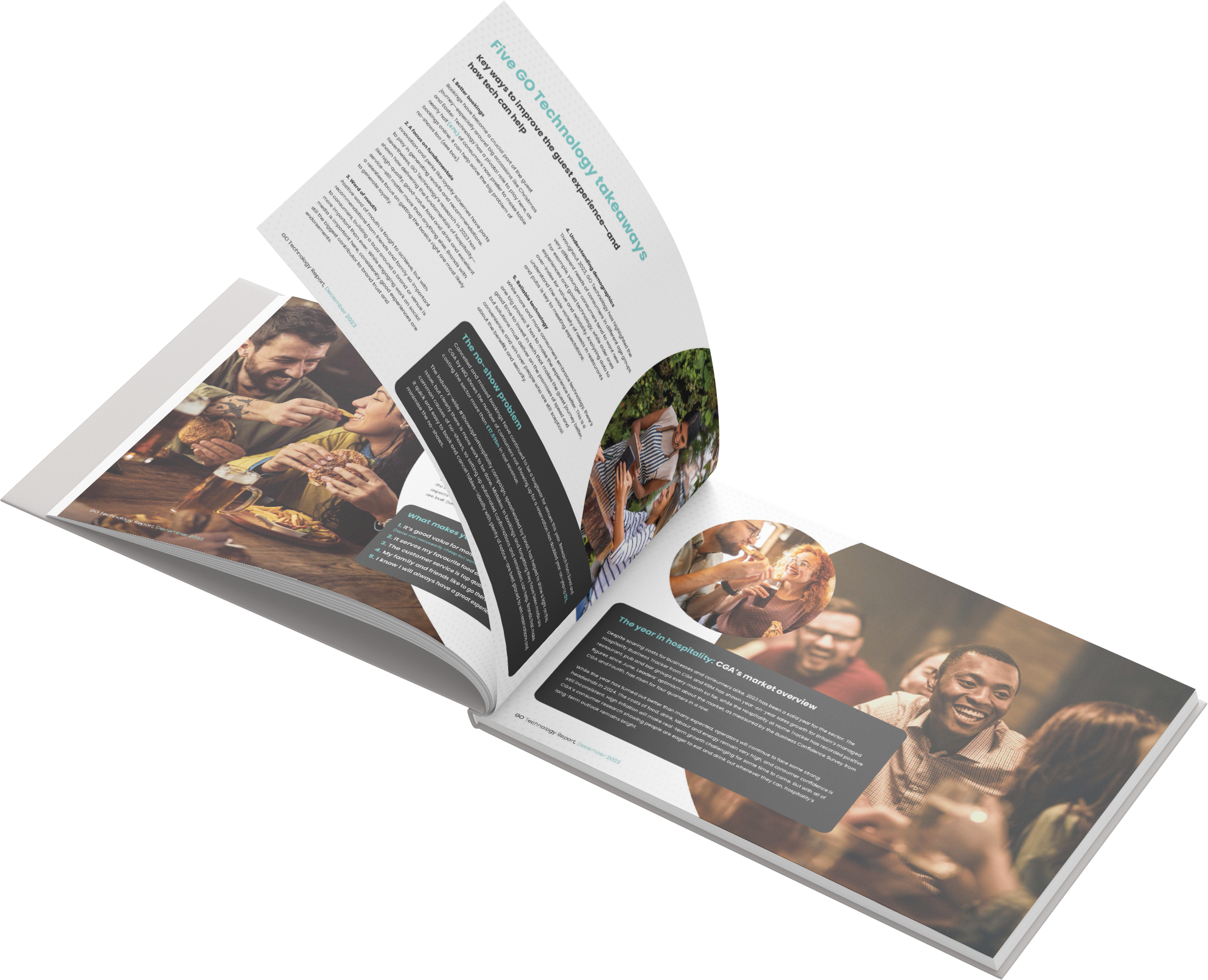
An in-depth end-of-year review of the key findings from our 2023 GO Technology consumer research series
Consumer expectations of the pubs, bars and restaurants they visit are ever-changing, and 2023 has proven to be no exception to the rule. This year, consumers have been quick to change their behaviours to match the tightening of budgets brought on by the cost-of-living crisis, and as more and more consumers become digital natives, the shift towards more digital-led touchpoints has continued to grow.
In this in-depth review of our 2023 consumer research series, we explore the three key themes identified from our surveys of 5,000 hospitality consumers; from the influential consumers who make the decisions on where to eat and drink, to when guests prefer digital touchpoints to human interaction during the customer journey, and how guest loyalty has changed as a result of the cost of living crisis.
Download this report to discover:
- 2023’s key hospitality consumer trends
- What factors most influence consumers’ decisions on when and where to go out to eat and drink
- What makes consumers loyal to a brand or venue
- How technology can help enhance the guest experience
Explore our 2023 consumer research in full
Subscribe to get the latest news, product announcements and industry updates
Unleashing Hoteliers Full Potential with PMS On-Site Training
In the dynamic landscape of hotel management, staying ahead of the competition requires mastering cutting-edge tools. One such tool that has revolutionised the industry is our Property Management System (PMS). With our intuitive and easy-to-use system, hoteliers all over the country are reaping the rewards; increasing direct bookings, maximising revenue, and improving operational efficiency, to name but a few.
What’s more, with our unwavering commitment to delivering value to our customers, we have introduced on-site onboarding and refresher training. These programs are meticulously crafted to empower users, ensuring our customers are not only grasping the intricacies of the system but also harnessing its full potential to maximise revenue and hotel efficiency.
Benefits of On-Site Training
#1. Hands-On Learning Experience
Our on-site training provides customers with a hands-on learning experience, allowing them to navigate the software in a real-world setting. This approach fosters a deeper understanding of the PMS and its features.
#2. Tailored to our Hoteliers’ Needs
We customise our training to meet the specific needs of the hotel. This ensures that staff learn how to apply the software in ways that align with the unique operational processes of their business.
#3. Immediate Issue Resolution
These face-to-face sessions enable immediate issue resolution. Participants can seek clarification on any doubts or challenges they face, fostering a more interactive and engaging learning environment.
#4. Increased Engagement and Collaboration
During our on-site training sessions, we encourage collaboration among team members. Participants can share insights and learn from each other’s experiences, creating a collaborative learning atmosphere that extends beyond the training sessions.
#5. Adaptability to Learning Styles
People have diverse learning styles, and our on-site training accommodates these differences. Trainers can adjust their approach based on the participants’ preferences, ensuring that everyone grasps the material effectively.
#5. Personalised Feedback
Our on-site trainers can provide personalised feedback to participants, identifying strengths and areas for improvement. This individualised guidance helps staff refine their skills and maximise their expertise when using the PMS.
#6. Boost Staff Confidence
The confidence gained through face-to-face interactions can be a significant motivator. Staff feel more secure in their abilities, increasing efficiency and productivity when implementing the software in their daily tasks.
#7. Cost-Effective in the Long Run
While on-site training may seem more costly initially, the long-term benefits often outweigh the initial investment. Reduced errors, increased efficiency, and improved collaboration contribute to overall cost-effectiveness in the implementation of the PMS.
Customised onboarding training for a large hotel chain
When a large hotel chain which is a dynamic player in the hospitality industry, sought to seamlessly onboard nine new sites, they encountered challenges rooted in differing cultures. Recognising the critical need for a smooth transition, they enlisted the expertise of Zonal Hotel Solutions for a customised onboarding training program.
Our onboarding training not only addressed the technical integration of the new system but also tackled cultural differences, ensuring a unified and harmonious adoption of Zonal’s PMS across all nine sites.
Understanding the diverse needs of each site, we conducted tailored training that addressed the unique requirements of each hotel. This hands-on approach allowed teams to familiarise themselves with the PMS in context to their specific operational processes.
What’s more, our on-site training facilitated open forum discussions where team members could voice their concerns and expectations. This transparent communication channel helped in building trust and addressed apprehensions related to the transition.
To conclude, investing in on-site training, whether a brand-new customer looking for onboarding training, or existing customers considering refresher training, proves to be a strategic move for hotels aiming to optimise their management processes.
The numerous benefits, including hands-on learning, immediate issue resolution, and increased employee confidence, position on-site training as a valuable asset in maximising the potential of your PMS software. As the hotel landscape continues to evolve, hoteliers embracing on-site training are poised to stay ahead of the curve.
Optimising Operations with Refresher Training for an Independent Hotel
A prestigious estate hotel known for its historic charm and upscale events sought to enhance the efficiency of its property management processes. Having previously implemented Zonal’s Property Management System (PMS), they recognised the need for a refresher training program to ensure their team fully leveraged the software’s capabilities.
The training was designed to be comprehensive, covering both fundamental features and the latest advancements in the software. Zonal Hotel Solutions worked closely with the hotel staff to understand their unique challenges and tailored the refresher program accordingly.
This included a review of core features, personalised troubleshooting sessions, and an in-depth exploration of new functionalities relevant to the estate’s property management requirements. Not only that, but our training also prioritised hands-on learning experiences, allowing the team to apply theoretical knowledge in practical scenarios. This approach facilitated a deeper understanding of the software’s capabilities and boosted confidence in day-to-day operations.
To conclude, investing in on-site training, whether a brand-new customer looking for onboarding training, or existing customers with considering refresher training, proves to be a strategic move for hotels aiming to optimise their management processes.
The numerous benefits, including hands-on learning, immediate issue resolution, and increased employee confidence, position on-site training as a valuable asset in maximising the potential of your PMS software. As the hotel landscape continues to evolve, hoteliers embracing on-site training are poised to stay ahead of the curve.
blog
Ask the Expert: Creating a successful hotel social media strategy
We sat down with Stewart Moss, Managing Director at Zonal PMS to explore how hoteliers can ensure they’re capitalising on the opportunities social media brings, from engaging with your audience and responding to queries and feedback, to leveraging your social platforms as a revenue-driving channel.
Subscribe to get the latest news, product announcements and industry updates
In Conversation: Social media's role in boosting direct bookings
Our recent GO Technology research Holidaying at Home: What guests want from hotels in 2023 uncovered social media as an increasingly important discovery and booking tool for guests searching for accommodation, with 60% of guests aged 18-34 looking at a hotel’s social media pages prior to making a booking, and 43% of consumers agreeing that a button to reserve direct through social media would make their booking journey easier.
In this episode of In Conversation, we sat down with the Institute of Hospitality and their members to explore the role social media can play in driving direct bookings for hotels, including how hotels can leverage their online presence to encourage guests to book, reaching the right audiences and the importance of responsiveness in building trust with guests.


Watch the discussion for actionable insights, including:
- What should a hotel’s social media strategy look like?
- The importance of optimised websites, booking journeys and social media in driving direct bookings
- How social media can provide a ‘safety net’ for guests’ bookings
- The role recommendations and reviews play in guests’ decision making