











-

Guides
The Loyalty Landscape

For most of your customers, their mobile device will probably never be more than a few metres away from them, so it’s likely that a customer’s first, last, and possibly only digital experience of your hospitality brand will be on their mobile device.
In fact, the 2020 Ofcom UK benchmark found that over four-fifths of time spent online is now spent on mobile devices in the UK. What’s more, the world’s biggest search engine, Google, switched to mobile-first indexing in March 2020, which means that it primarily uses the mobile version of a site’s content – instead of the desktop version – to rank pages from that site, proving just how important the experience of your brand is on a mobile device.
On top of the natural growth of mobile devices, the pandemic has accelerated usage even further in our everyday lives, including how we now work remotely, browse and shop online, and stay in touch with our family, friends, and colleagues.
A mobile-first strategy is a term that has been around for just over a decade and is used to describe an approach where digital interactions are designed and created with mobile devices front-of-mind. Mobile-first, however, doesn’t mean mobile-only; it should mean that the experience has been optimised and tailored for a mobile device.
We’ve included some top tips and pointers below, to help you ensure your guest journey is mobile-optimised:
The future of mobile will continue to be dictated by customer behaviour and tech innovation, but one thing the pandemic has shown is that the hospitality industry is more than capable of adapting quickly to these needs.
Get in touch with Zonal today to discover how our connected technology solutions are helping hospitality businesses of all shapes and sizes to understand and enhance their customer journeys, make significant service improvements and exploit new revenue streams.

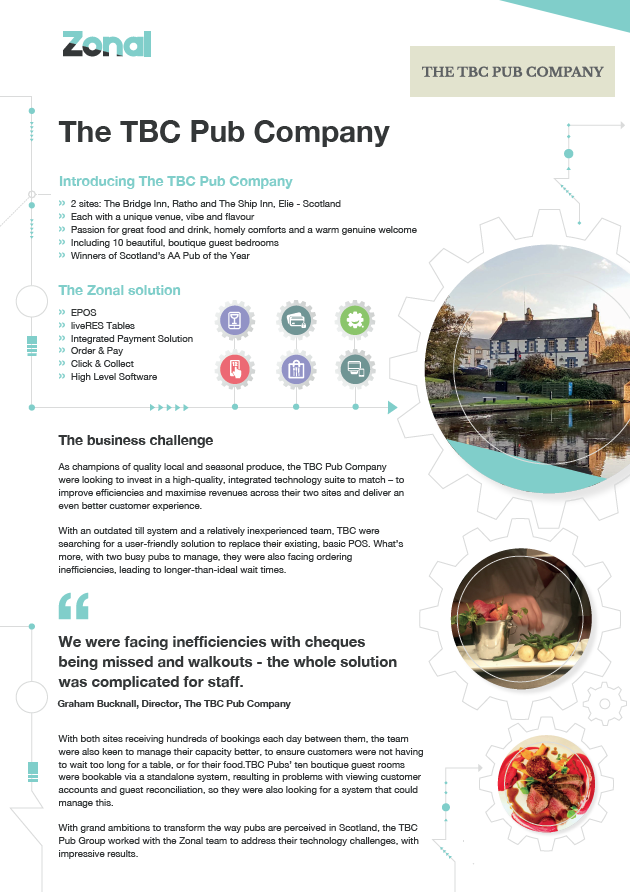
Three sites: The Bridge Inn, Ratho, The Crusoe, Largo and The Ship Inn, Elie – Scotland

10 beautiful, boutique guest bedrooms

Winners of Scotland’s AA Pub of the Year

Each with a unique venue, vibe and flavour
“We were facing inefficiencies with checks being missed and walkouts – the whole solution was complicated for staff.”Graham Bucknall, Director, The TBC Pub Company
As champions of quality local and seasonal produce, the TBC Pub Company were looking to invest in a high-quality, integrated technology suite to match – to improve efficiencies and maximise revenues across their three sites and deliver an even better customer experience.
“Zonal’s back-office system is simple and intuitive for our front-of-house staff to use and has brought in tighter cash control – exactly what you’re looking for as owners of the business.”Graham Bucknall, Director, The TBC Pub Company
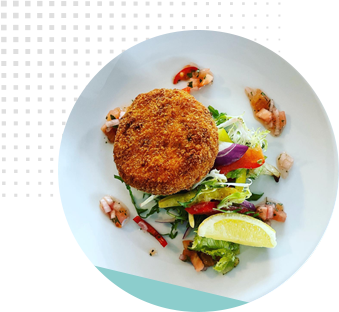
TBC Pubs invested in Zonal’s core EPoS solution to begin with. Having heard good things from previous users, they trialled a few systems and settled on Zonal. Since then, they have also adopted Zonal’s integrated payment solution, Order & Pay, Click & Collect, online bookings and table management, and our property management system, High Level Software.
“When compared to other apps, we found Zonal’s to be much cleaner and easier to navigate; we found the cheaper apps didn’t look as professional, with only basic branding and customisation options. Our customers often say it looks like we built it ourselves, it looks and feels expensive!”Graham Bucknall, Director, The TBC Pub Company
Implementing Zonal’s integrated solutions has given TBC Pubs a huge range of benefits across every level of the business.





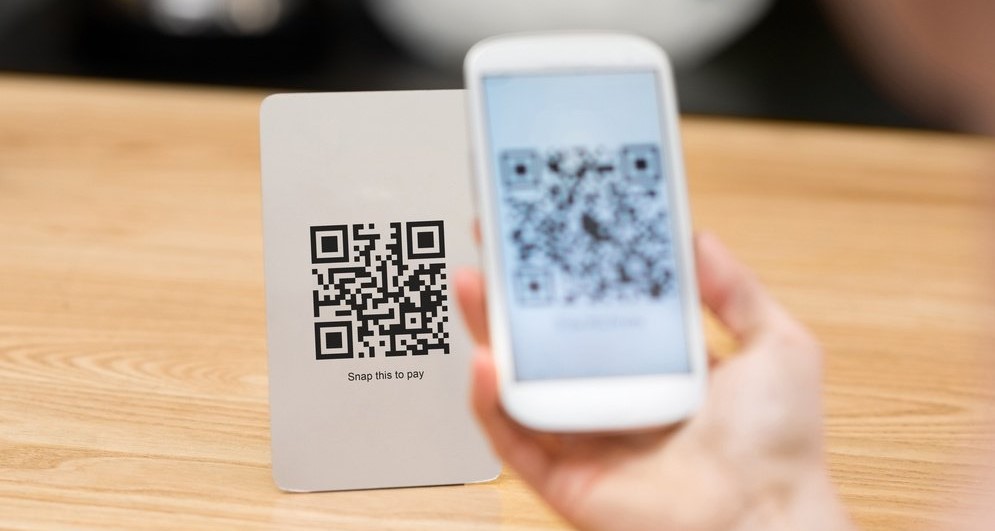
The word ‘friction’ then, is the opposite to this, where obstacles can occur at various touchpoints throughout the customer journey. From finding a venue and booking to ordering and paying, potential obstacles exist to detract from the customer experience. Understanding these potential points of friction and removing them is as good for your business as it is for your customers.
Source: Plan to Plate Research Report, May 2021, KAM Media/Zonal
Results from Zonal’s GO Technology research programme, and more recently Plan to Plate in partnership with KAM Media, repeatedly cite not being able to attract the attention of the server to order or pay the bill among consumers’ top frustrations. Customers actively want to pay quicker. And quicker payment means quicker table turns, which means extra capacity and ultimately extra revenue.
Removing friction, it would seem, is a win-win!
Since the Coronavirus pandemic hit at the beginning of 2020, QR codes have experienced a come-back as a simple solution that can achieve everything from checking in for Track and Trace to viewing digital menus. The development in smart phone camera technology that enabled QR code recognition and redirection to website pages has meant that QR codes are now a simple solution to many of the points of friction in the hospitality customer journey.
Whilst a primary benefit of using QR codes in-venue may be to enable quicker payment of the bill, they also allow fewer steps and fewer button clicks to order, plus improved accuracy of ordering. All the customer needs to do is scan a code, taking them directly through the ordering process at the correct venue, at the correct table – they just need to choose their food and pay.
Zonal has long recognised that enabling hospitality businesses to provide easier and quicker ways for guests to order and pay will not only increase guest satisfaction but will make ordering more efficient, increase revenues and cut down waste.
Discover how Zonal’s connected technology solutions can help you understand and enhance your customer journey.

Whether you’re launching a pay-at-table service, loyalty app or any other mobile service which requires a change in customer behaviour or operational processes, it’s essential that as much time and effort goes into the launch as did the development – to ensure your new tech investment is a success.
Zonal’s Matt Brooks shares his top suggestions for a successful app launch, based on some of the best we’ve seen over the past few years:
The most important people to get on board in any new app roll-out are your front-of-house team. But this also extends to senior management and the board (if you have one). Why have you invested in this technology in the first place – is it to increase revenue? To encourage repeat business? To reward loyal customers? Whatever your reasons, explain what the benefits will be to your customers, to your staff and to the rest of the business. Encourage them to give their feedback and ideas on how to make it a success and of course get them to try out the new app for themselves to see how easy it really is to use. Finally, make sure any concerns are acknowledged and addressed.
If you don’t focus on achieving this one, you may as well ignore the rest of this list… it really is that important!
Make sure any new mobile ordering technology supports staff tipping – especially when the new service is replacing a task that the front of house team may have undertaken as part of their role, such as order and pay at table. Any negative impact on tipping will inevitably have a knock-on effect to how much staff are willing to promote the new service. Make sure this is also communicated to staff, including how and when they will get their tips.
Organise a series of dedicated training sessions for staff before launch, where you can provide a safe, non-live environment to help them get comfortable with the solution and practice real-life scenarios before they happen. This can also provide a great opportunity to gather feedback from the team and win their buy-in.
When considering the communications channels and touchpoints you plan to use to launch the new app, remember to lead with the key customer benefits. Think: ‘what’s in it for them?’ Why should they download it? Can they pay the bill quicker? Can they get a round of drinks at the touch of a button? Can they avoid the queue at the bar? Is there a special offer or discount? If they understand the benefits, they’re more likely to adopt the new app.
Think about where and how you will promote your new app and make sure you promote your new service everywhere you can – the more visible reminders the better. Consider table point of sale materials such as menus and flyers, as well as till receipts and staff clothing to help spread the word. Use all areas in-venue to advertise the new service: reception, bar, lounge or smoking area and even the back of toilet doors (yes really!).
Whether it’s a free drink, dessert or starter, if you’re asking customers to hand over their details, register for a service, download an app or even use the ‘guest checkout’ facility, launch offers or incentives are a great way to generate engagement in your new service.
Your app is an important part of the customer experience. It is vital to actively solicit and respond to stakeholder feedback throughout all stages of the roll-out. Listening and responding to feedback and suggestions, adapting the technology itself or your communications will help to ensure its success in the long term.
Be transparent with the results – share the key numbers and metrics with the team: downloads/usage, spend per head, number and increase in orders, contribution by channel, dwell time, customer satisfaction. Something as simple as a small reward or team prize could help galvanise staff to hit and exceed any targets you’ve set for the new service.
If yours is a multi-site business, leader boards can be a great way to drive behaviour and new app adoption. Encourage competition between staff and sites by offering a prize for the most revenue/registrations/downloads/new members via the new service.
Zonal is trusted to power mobile ordering technology for thousands of customer sites around the country. To find out more about our EPoS-integrated mobile ordering solutions, visit our dedicated web page >

The pandemic has given mobile ordering and payment a real shot in the arm, so to speak…
Even prior to the pandemic it felt as if the industry was reaching a tipping point in terms of adopting digital order and pay products, but lockdown has undoubtedly accelerated this. Zonal has been at the forefront of such technology for many years but over the last 12 months we’ve seen a 500% increase in the take up of our order and pay solutions.
What would you say to operators that are still on the fence about the technology?
There is now a real danger for any operator left behind, as shown in our recently published GO Technology report. In a survey for the report 34% of consumers told us they would be more likely to choose a venue with order and pay technology and 40% feel safer in venues that use it. The report also found that three quarters of consumers are satisfied, or very satisfied, with the ease of digital ordering and payment and satisfaction levels are similarly high for ease of set-up and user-friendliness.
How big do you see mobile order and payments getting?
We believe order and pay will become not just standard but something people expect. Suddenly removing it so consumers find themselves having to queue at the bar again will result in frustration. And any operators still concerned that order and pay technology could detract from the guest experience by limiting interaction with team members, should bear in mind that a properly thought-out solution will give staff more time to have meaningful interactions with guests.
What are the benefits for operators?
Of course, order and pay technology doesn’t just benefit consumers. There are significant advantages for operators too – and those benefits are especially pronounced where systems can be integrated. The Zonal platform for example, is integrated to our POS in real-time, and powers our order and pay, click and collect, and loyalty white label apps, as well as our more recently developed browser-based ordering system. And it handles integration with third parties too, including the major delivery players, including Deliveroo and UberEats.
What are the benefits of a fully-centralised system?
Everything is managed in one place, meaning operators can easily see orders, manage menus and pricing in real-time across multiple platforms and from multiple channels – including different delivery partners. There’s no double keying needed, saving a significant amount of time and removing the risk of human error.
Any examples?
Take digital menus. Operators have reported that one of the major advantages of these over analogue menus is dynamic pricing – the ability to change prices according to the day of the week or time. A digital menu can also be set to automatically suggest add-ons and upgrades, perhaps offering people a side or the option to switch normal fries for sweet potato fries. Traditionally, operators have had to rely on staff to remember to do this but those using our system have found that automating the process yields great results for the bottom line.
What’s coming down the track that might shake things up?
This area of technology is a fast-moving space. One thing to look out for over the coming months is the rollout of Apple’s App Clips. These are essentially mini versions of apps that don’t take up much space and – crucially – appear the moment a customer needs them. This is an area Zonal is looking at, as it offers the best of both worlds – a native experience that’s as quick as using a mobile website. App Clips are also the gateway to customers downloading the full app with additional functionality, such as loyalty features.
Where does Zonal stand on the app versus browser-based order and pay debate?
At Zonal we offer both solutions so it’s an and/or for us rather than versus. The beauty of technology today is that it can be on whatever platform the customer wants to use it on. The main advantage of apps is that they tend to be quicker, slicker and have the potential to offer more functionality, while browser-based solutions are instant and don’t require a download or a smartphone.
Any other predictions for mobile ordering and payments?
Increasingly, we’re going to see hospitality businesses borrow from the playbooks of the likes of Amazon and Netflix to drive profitability. Personalisation is going to be key, but a balance does need to be struck between offering the customer the same thing over and over again and encouraging them to try new things. Ultimately, every restaurant and pub will use technology slightly differently but there’s always a way that it can improve operations for the business and the experience for the customer.
COVID-19 has put technology in the centre of the consumer journey and hospitality’s safety precautions, our GO Technology report reveals how consumers have reacted to this change.

Amidst a challenging trading environment for pubs, many operators will be looking to use every tool at their disposal to help them better navigate rising costs, protect their margins, drive revenue and enable their team to achieve more.
Powerful pub tech, which has previously only been seen as viable for the big brands is now more accessible than ever, and the value it can add for smaller businesses – from independent village pubs to groups with aspirations for growth – has never been more apparent. In this guide, we explore the different solutions available to pub operators, and how this technology can help pubs meet their objectives.


Guides
The Loyalty Landscape


Research
GO Technology: The social value of hospitality

Webinars & podcasts
People Make The Experience: How Your Staff Drive Customer Loyalty

Webinars & podcasts
It Should Feel Like Magic, Not Marketing: Personalisation, Loyalty & Data in Hospitality

Webinars & podcasts
Loyalty That Lasts: Growing with Guests, Not Just Points

Webinars & podcasts
What Diners Want: The New Rules of Loyalty in Hospitality


Blog
How hospitality businesses can create ‘Superfans’

Blog
How loyalty can help tackle no shows

Technology continues to play a vital role in the running of a restaurant business. With consumer demands always changing, many technologies previously associated with larger restaurant groups have become widely adopted, enabling restaurants of all sizes to meet these ever-changing consumer expectations, as well as navigate the challenges faced by hospitality in the current trading environment.
In this guide, we explore some of the different technology restaurant operators should be considering implementing into their venues, the benefits these solutions bring to the table, and the importance of choosing the right tech partner to work with when considering a new system.


Guides
The Loyalty Landscape
Research
GO Technology: The social value of hospitality
Webinars & podcasts
People Make The Experience: How Your Staff Drive Customer Loyalty
Webinars & podcasts
It Should Feel Like Magic, Not Marketing: Personalisation, Loyalty & Data in Hospitality
Webinars & podcasts
Loyalty That Lasts: Growing with Guests, Not Just Points
Webinars & podcasts
What Diners Want: The New Rules of Loyalty in Hospitality
Blog
How hospitality businesses can create ‘Superfans’
Blog
How loyalty can help tackle no shows

Most notable of these have been order and pay at table solutions – from apps to web ordering, which, prior to the Coronavirus pandemic were still emerging technologies – used mainly by early adopters – both operator and consumer. Zonal and CGA’s GO Technology research programme has been tracking the adoption of order and pay technology over the past two years, and findings from the most recent study show that the percentage of UK adults using order and pay tech has more than doubled since before the pandemic – up from 18% to 43%.
And consumers have reacted positively to the new ordering channel. Just over three quarters (77%) say they have been satisfied or very satisfied with the ease of ordering, and even more (79%) with the ease and speed of payment – a notorious and recurring pain point for customers in hospitality venues.
Whilst order and pay was previously viewed with scepticism by some as a replacement to human interaction, it has in fact, enhanced the customer experience and served to provide reassurance for customers around safety issues. According to the 5,000 UK adults surveyed: nearly nine in ten (86%) of those who used order and pay solutions reported that their interaction with staff was the same or better than it was before lockdown, and 40% of consumers say they feel safer in venues that use order and pay technology. A further third (34%) stated that they would be more likely to visit a venue that has order and pay technology.
So is order and pay here to stay? With current adoption almost doubling compared to pre-COVID times and almost half of 18-44 year-olds intending to use the technology going forward, even when COVID measures no longer need to be implemented, we say yes.
Download GO Technology: Order and Pay Technology in the COVID-era for further insights on this emerging technology trend

The COVID-19 pandemic has put digital solutions at centre stage in the consumer journey and hospitality’s safety precautions, but how have consumers reacted to this change when eating and drinking out? Zonal and CGA’s latest GO Technology report reveals its latest findings.
Before the pandemic, around a fifth (18%) of the 5,000 UK adults surveyed, said they typically used technology to order and pay for food and drink. However, that number has more than doubled to 43% since hospitality reopened emphasising the pivotal role that technology has played in hospitality since the end of the first lockdown.
The GO Technology findings emphasise the very close correlation between digital ordering solutions and customer concerns over safety. Some 40% of consumers say they feel safer in venues that use order and pay technology, demonstrating how it has been an important tool in operators’ efforts to give people the confidence to eat and drink out during the pandemic. And this is a factor when choosing a venue with more than a third (34%) stating they would be more likely to visit a venue that has order-and-pay technology.
How have customer reacted to the change, what’s driving their behaviour and needs? Download the full report to uncover all the findings.
About the data
The report is based on figures from Zonal and CGA’s GO Technology survey, a sample of 5,000 nationally representative British consumers. All figures are taken from the October 2020 edition of the survey. The frontline perspective is taken from a survey to CGA’s Hospitality Professionals panel.

As the industry emerged from lockdown, technology very quickly became the solution to a whole raft of new challenges, from social distancing to table service and contactless payment, leading to an acceleration of three to five years in the demand and usage of self-ordering and payment solutions. At Zonal alone, we’ve seen over 40 times the amount of orders go through our online ordering platforms than prior to COVID!
Many operators were forced to adopt new technology solutions at record speed, or make better use of those they already had over the past few months – for everything from managing bookings and capacity, to creating completely new ordering channels via click and collect and delivery. 48% of business leaders suggest that implementing new technology has been a major, or their biggest focus post lockdown to help safely reopen their businesses.
Fast forward seven months and we were presented with a second lockdown. So how can you use this time effectively? What have we learned and how are things different this time round?
Many of our customers are using this time to build for the future, not just for post-lockdown – planning long-term operational strategies, and for many this includes reviewing their entire technology suite.
Now is the time to look back and reflect how this tech is performing
You’ve implemented online ordering, click and collect or delivery. What now?
Having embraced these new technologies, it’s time to ask some serious questions of them – are you getting the most out of the solutions? Are they performing as you hoped they would? Is your provider giving you the right level of support or has it highlighted the cracks in your tech infrastructure? Has it put pressure on other systems showing they can’t cope with an omnichannel approach? A technology review will reveal the strengths and weaknesses of these solutions to ensure they are fit for purpose and capable of delivering your business needs.
Not sure where to begin? Here are a few points to consider when undertaking your review:
Do your platforms sit in silo or do they talk to one another, can you capture this data centrally to give you a single view of your operations? Is it giving you access to the insight and data intelligence that you need to help you make informed decisions?
Do your tech platforms offer everything you need to support all your operations? Are they adding more time pressure on your staff, for example do online orders need to be re-keyed into your POS or kitchen management system or accounting tool? How do you ensure nothing is missed and how do you account for human error? Are the systems giving you complete control of all your customer touch points?
With more ordering channels now available, this brings more opportunities for customers to engage with your brand. How is this being managed, is the brand experience consistent or is it being compromised? How do you ensure you offer the same experience customers expect from your brand even if they are not in-venue? Do the new platforms allow you to add your brand personality and unique offering, but still allow for that personal touch when needed?
How are you managing your available stock items or even available tables on different channels? Can customers order things that are no longer available? Not only is this an additional task for your staff to keep on top of but also leaves a negative impression of your brand with the customer.
You may have needed to act quickly in implementing your new solutions and not had time to complete all the research that you would normally do when choosing a new technology partner. How is the partner working for you, how are they supporting you during this time, if you need help can you contact them outside of the standard 9-5pm? Can they meet your growth plans and expectations, can they grow with your business? Ensuring a partner can provide solutions that can integrate into your existing technology infrastructure will stand you in good stead for a successful, profitable business in the future.
Adding new technology to your business to meet changing demands is not as simple as a tick box exercise, it’s not easy and you’re not alone, 94% of leaders suggest that implementing new technology is at least somewhat challenging, with 1 in 3 suggesting it is a major challenge. You need to review, listen to your customers and work with your technology partner to ensure you are providing the best experience to keep those loyal customers.
With customer touch points becoming increasingly varied and arguably more complex, the seamless data sharing and integration becomes ever more vital to ensure the customer experience is not compromised and to minimise the burden on operations. With a plethora of platforms now available to operators, never has there been a greater need for a holistic view of customer touch points and this can only be achieved through an integrated approach to technology. The data available from this approach will be invaluable to any business, it will aid planning, ensure operational efficiency and help meet your business goals not just for re-opening but for the future.
For a complete integrated approach, check out Zonal’s range online ordering tools